Frequently Asked Questions (FAQ)
Learn how to use EcoDrug+ for target conservation analysis and environmental risk assessment.
General Information
EcoDrugPlus (EcoDrug+) conceived and built through a research partnership between the Universities of Helsinki (Finland) and the University of Exeter (UK) is a database that expands considerably on ECOdrug (https://ecodrug.org/; Verbruggen et al., 2018 NAR 46: D930-D936) for connecting drugs and conservation of their targets across species allowing researchers to assess the conservation of drug and other small molecule molecular targets across species and predict their mode of action.
EcoDrug+ integrates (within an SQL relational database) data on 7,200 pharmaceuticals, 34000 agrochemicals, 61,000 human metabolites, and 5800 other bioactive chemicals, with information on chemical target conservation (i.e. protein targets identified by their amino acid sequences) for 180 organisms across divers phyla. EcoDrug + integrates data from ChEMBL, NORMAN, Ensembl, various other databases, together with some major manual inputs and curations (e.g. the metabolites for 450 compounds).
This integration thus provides a comprehensive ‘mechanism of action-based’ assessment for the potential effects of drugs and other bioactive chemicals discharged into aquatic and terrestrial environments.
Please cite our Nucleic Acids Research publication:
Ashenafi Legehar et al., EcoDrug PLUS: an advanced database for drug target conservation analysis and environmental risk assessment, Nucleic Acids Research, Volume 54, Issue D1, 2026. DOI: 10.1093/nar/gkaf1251.
Using the Platform (Example: Clozapine)
You can lookup compounds in the primary interface using their common name (Clozapine), CAS Registry Number (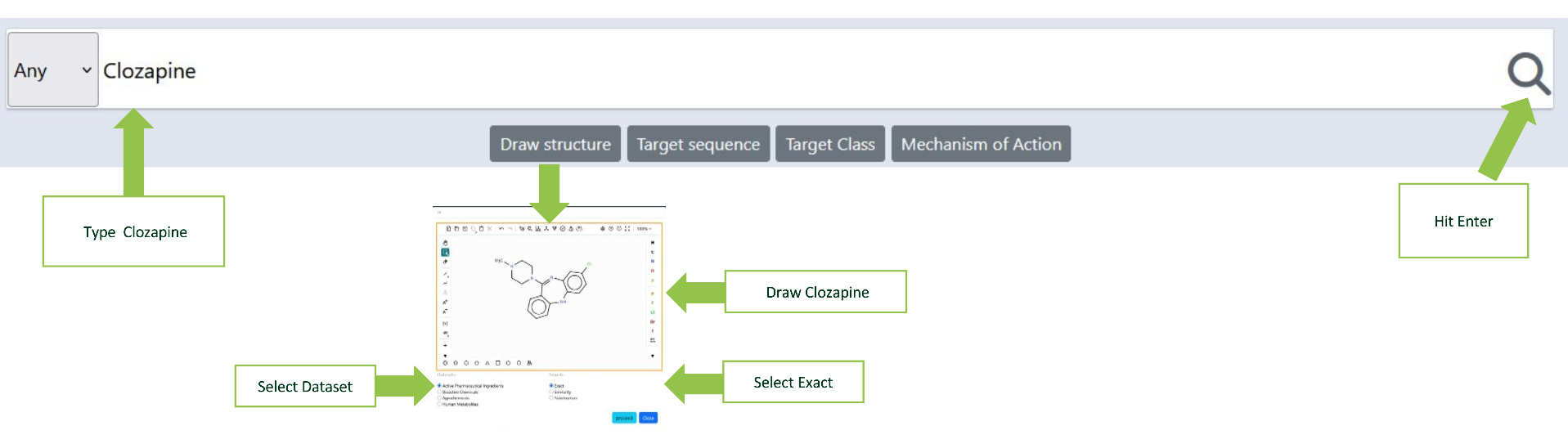
5786-21-0), or unique ChEMBL Identifier (CHEMBL42).
Chemical Selection & Identification
- Open the EcoDrug+ platform
- Navigate to the Chemical menu or search bar on the landing page.
- Input the common name or identifier for the compound: Search using Clozapine, CAS RN:
5786-21-0, the ChEMBL IDCHEMBL42or use the SMILES string:CN1CCN(C2=Nc3cc(Cl)ccc3Nc3ccccc32)CC1.
It uses Ensembl-derived phylogenetic comparisons to project human drug targets onto wildlife species.
Example: Searching Clozapine extracts its human pharmacological target profile—predominantly the Dopamine D2 receptor (DRD2)
and Serotonin 5-HT2A receptor (HTR2A). The tool runs a sequence comparison to evaluate if these specific receptors are structurally conserved across fish, birds, or amphibians
- Input Identifiers Enter your selected gene symbol or target
- Fetch Cross-Species target conservation
- Analyze the the target conservation (comprising 12–16 distinct taxonomic groups).Shaded or grayed-out icons represent groups where the gene target conservation is entirely absent.
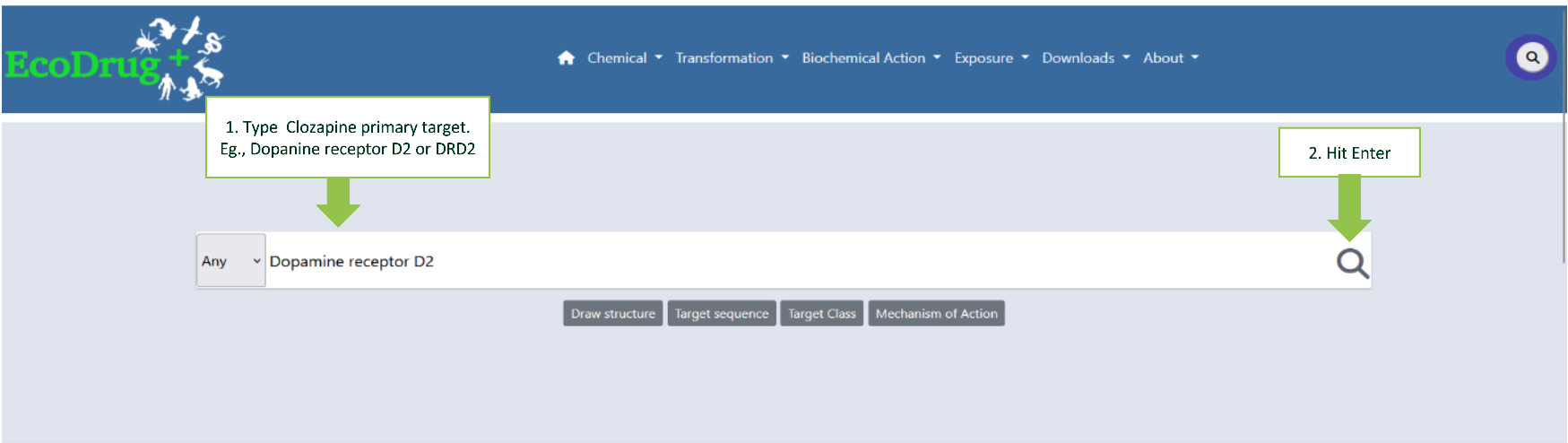
Search Result...
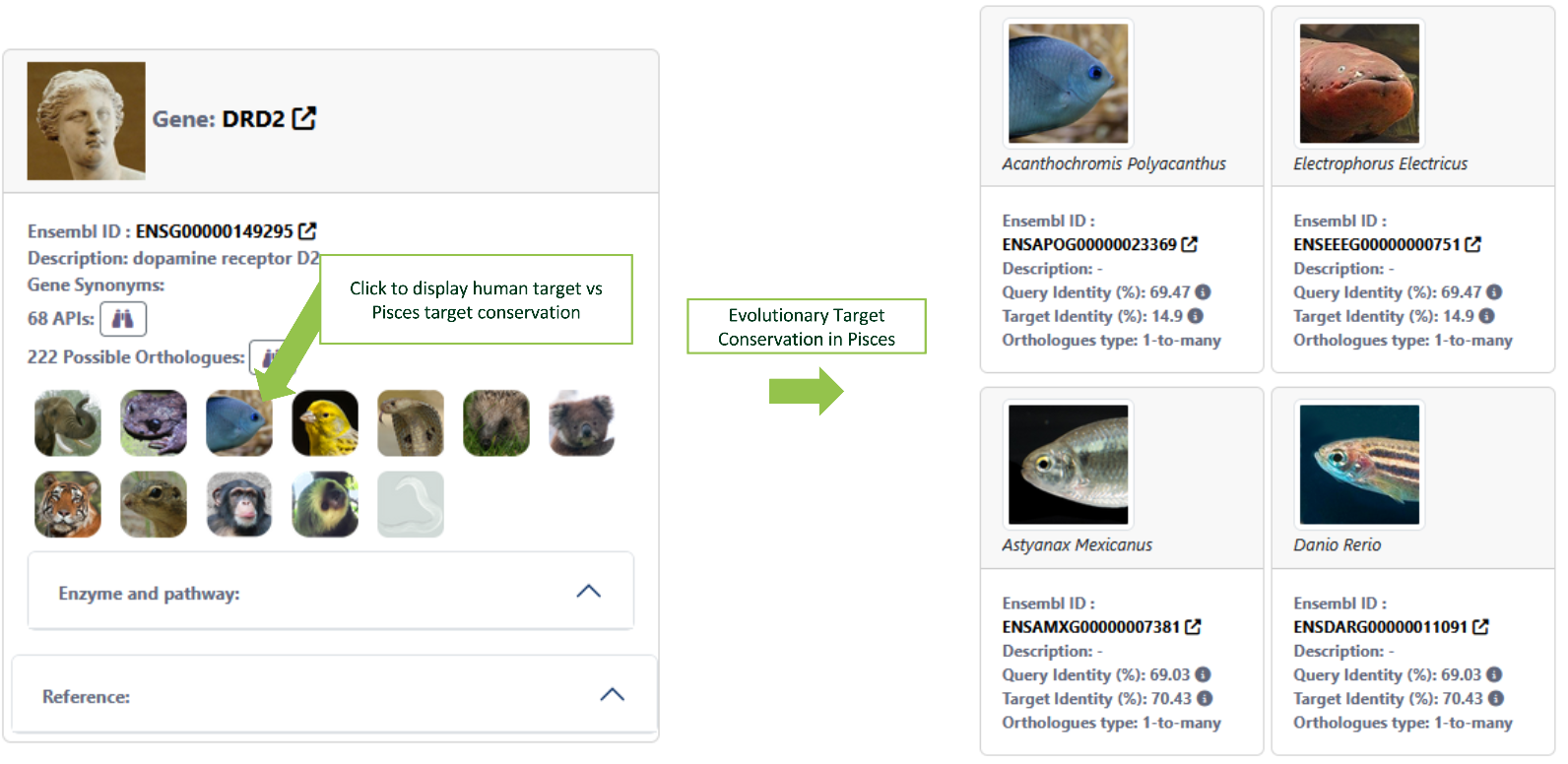 Evaluating Conservation Metrics & Sequence Identity
- Identify the primary targets for the primary targets
- Select BLAST from selected species from Biochemical menu
- Set up BLAST parameter
- Check Sequence Similarity (BLAST Results)
Step 1
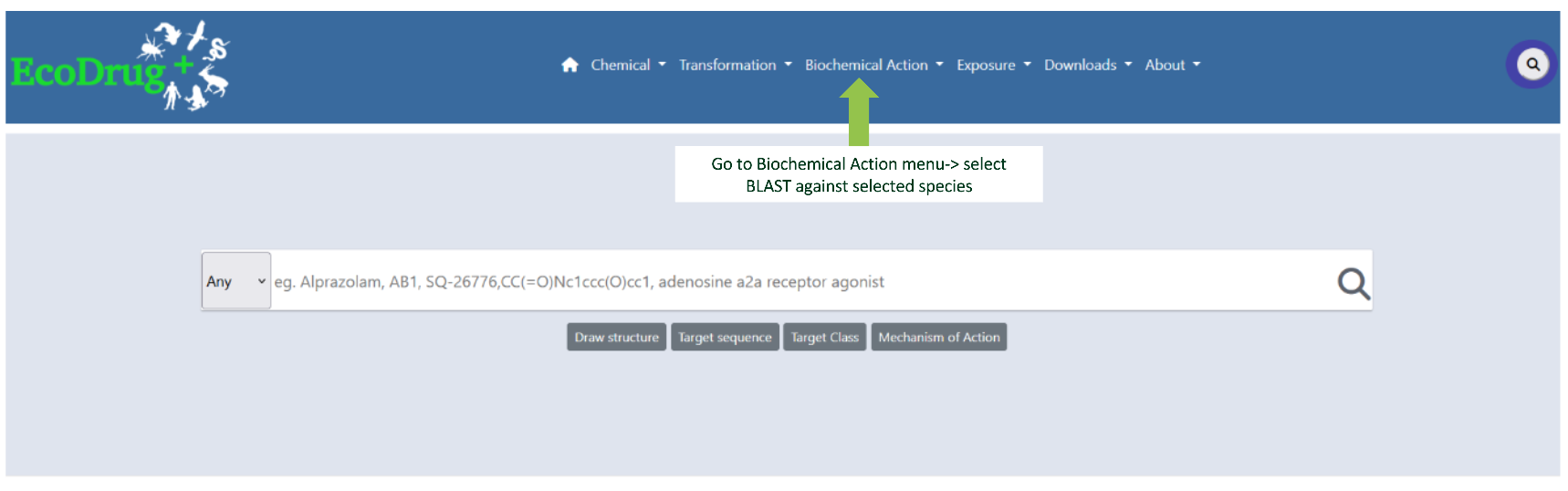
Step 2
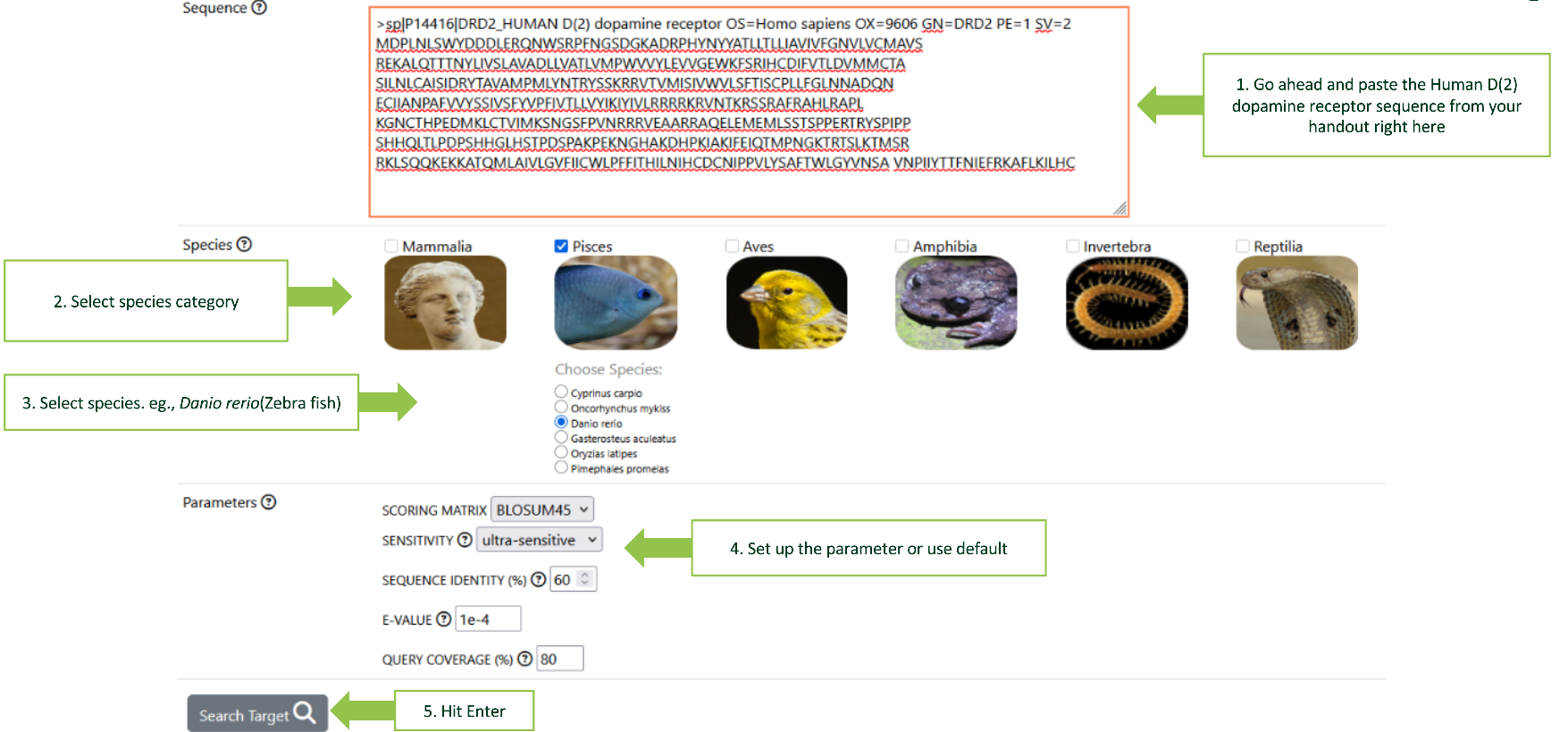
default: Designed for finding hits with greater than 60% sequence identity.fast: quick target alignments with close species matches (greater than 90% identity).sensitive: Explores deeper evolutionary links, tracking alignments down to highly divergent twilight zones (less than 40% identity).
By providing a chemical's SMILES representation (e.g., Clozapine: 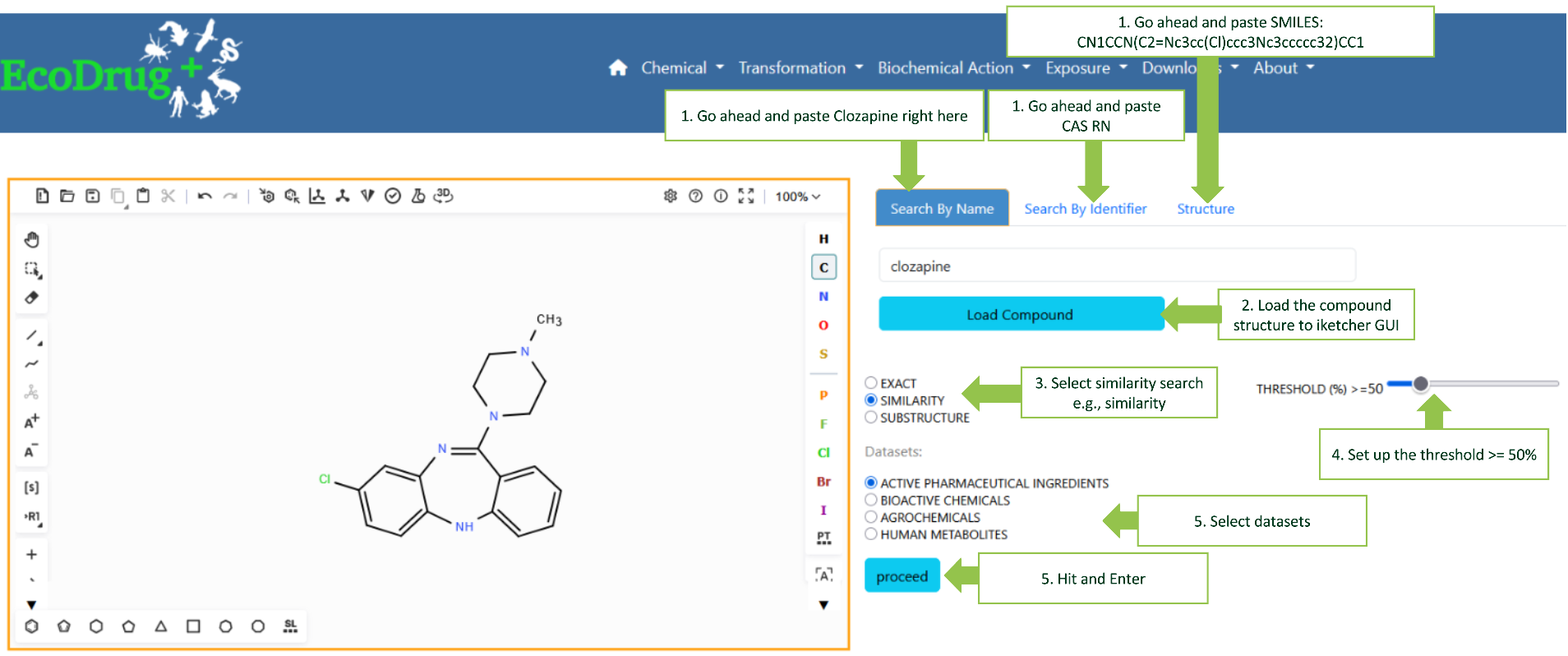
CN1CCN(C2=Nc3cc(Cl)ccc3Nc3ccccc32)CC1), users can execute Exact,
Similarity (Tanimoto calculation), or Substructure matches. This scans your molecule across roughly 7.2k pharmaceuticals, 34k agrochemicals,
and 61k active metabolites stored within our structural knowledge networks.
Setting Parameters and Running the Query
- Retrieve Clozapine structural data Obtain the exact structural format required by EcoDrug+.
While you can search by text name or identifier (CAS RN:
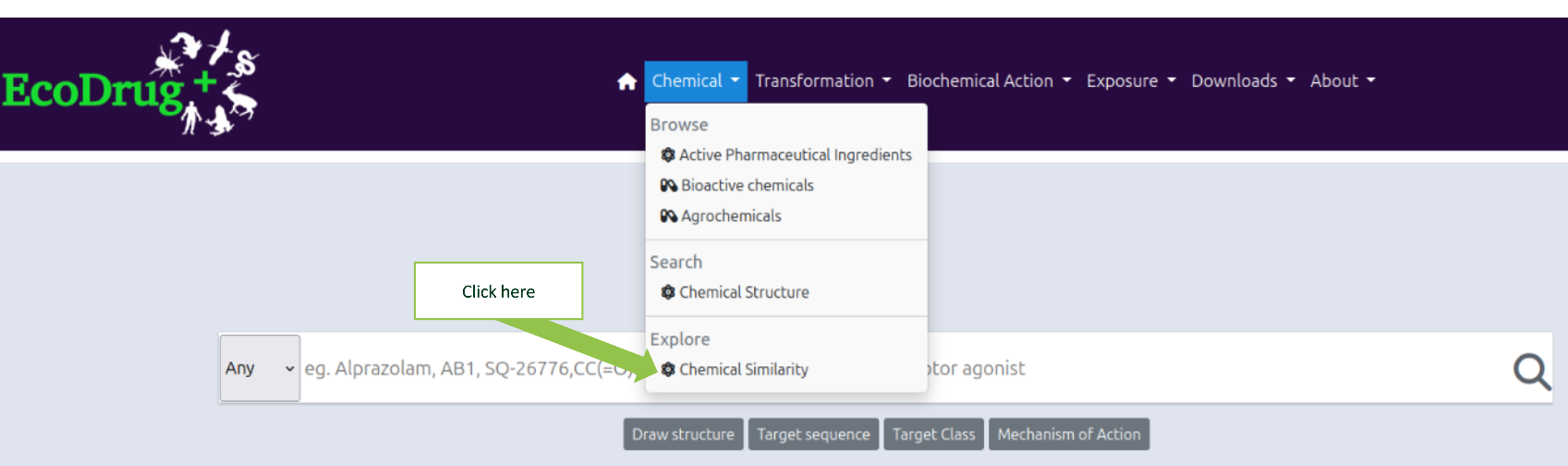
5786-21-0; ChEMBL ID:CHEMBL42), using the exact SMILES string:CN1CCN(C2=Nc3cc(Cl)ccc3Nc3ccccc32)CC1 - Open EcoDrug+ and go to the Chemical navigation tab, selecting Chemical Similarity or using the embedded structural drawing panel.
- Define Search Type & Tanimoto Threshold Choose Similarity Search rather than an Exact or Substructure search. Set your Tanimoto coefficient cutoff (e.g., Threshold >50%) depending on how broadly you want to capture structural analogues
Analyzing Clustered Analogues and Generating Knowledge Graphs
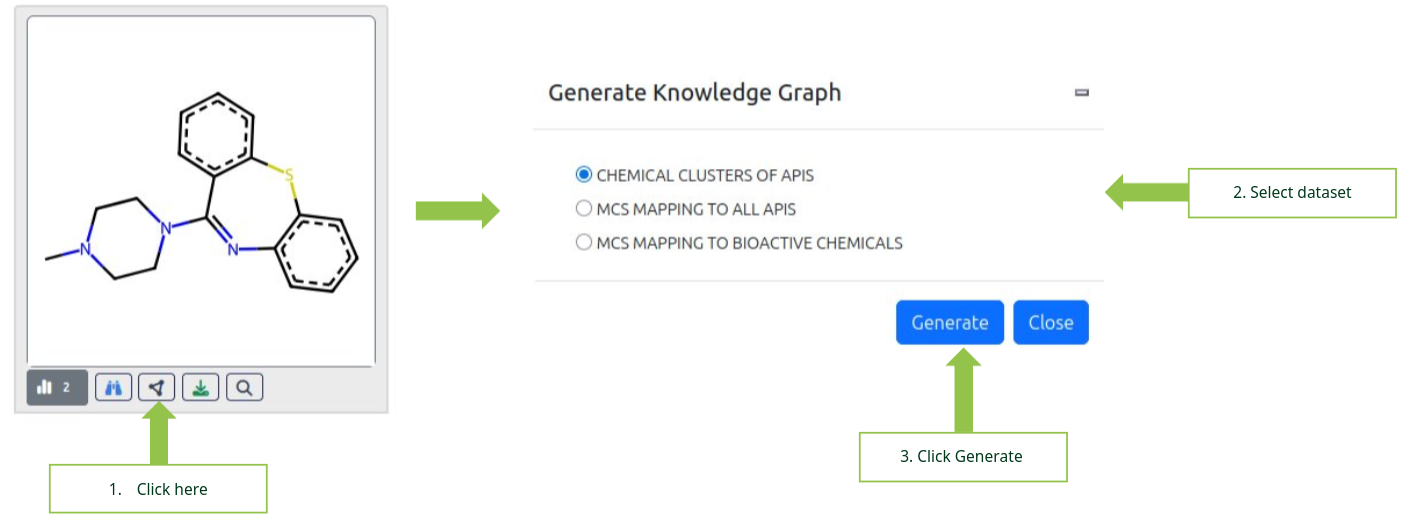
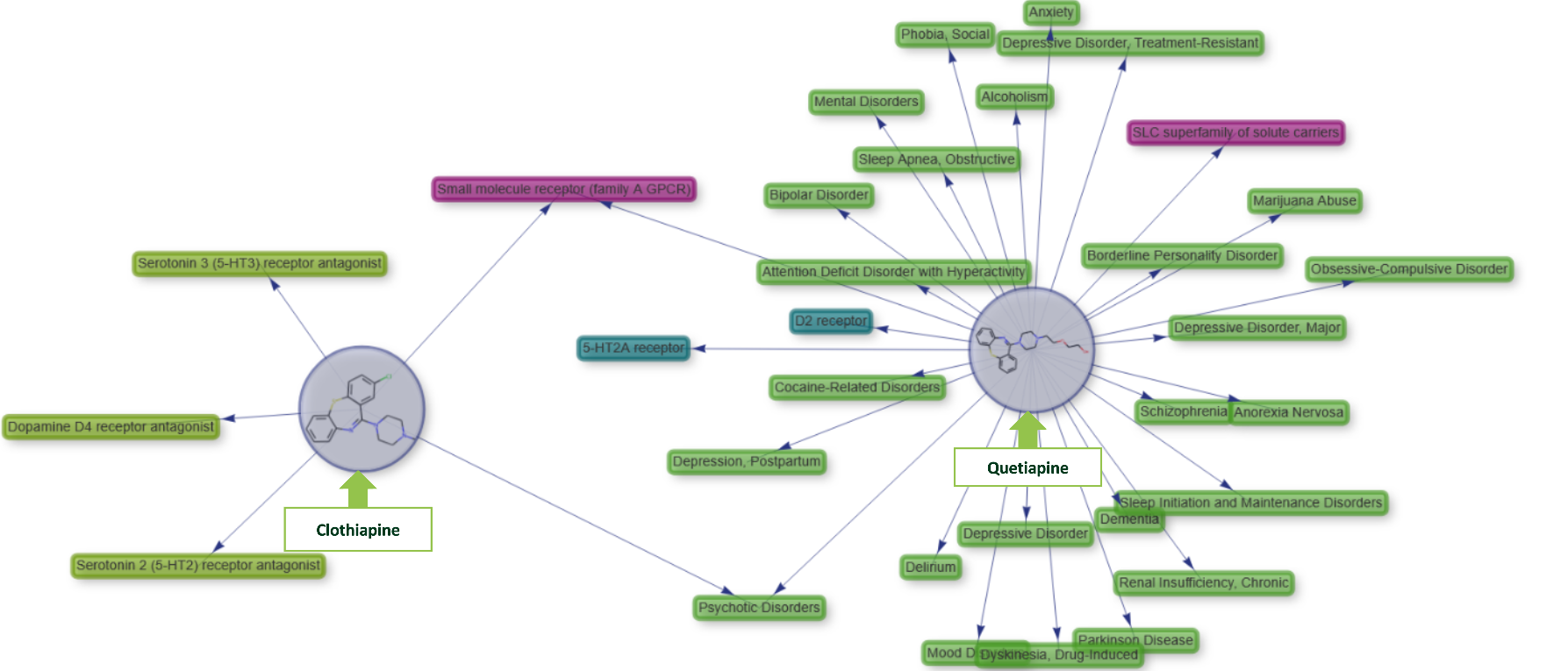
Step 1
Step 2
Result ...
API & Developer Access
Yes. EcoDrug+ opens programmatic read access for cross-platform data pipeline integration. Developers can seamlessly pull compound identities, compound structure, mechanisms of action, and pre-calculated conservation scores via standardized HTTP GET endpoints.
You can execute queries to pull real-time data matrices using Clozapine via our production REST architecture:
GET https://ecodrugplus.helsinki.fi/api/v1/data/Compounds/preferred_name/Clozapine
GET https://ecodrugplus.helsinki.fi/api/v1/data/DrugMechanism/preffred_name/Clozapine
GET https://ecodrugplus.helsinki.fi/api/v1/data/TargetConservation/organism/Homo%20sapiens/preffred_name/Clozapine
